
Wednesday, 11. November 2026
“Now I Can Just Get on My Tricycle and Go!”
Morris and his mother, Cynthia, explain how an adapted aid has transformed their daily lives and opened up new possibilities.
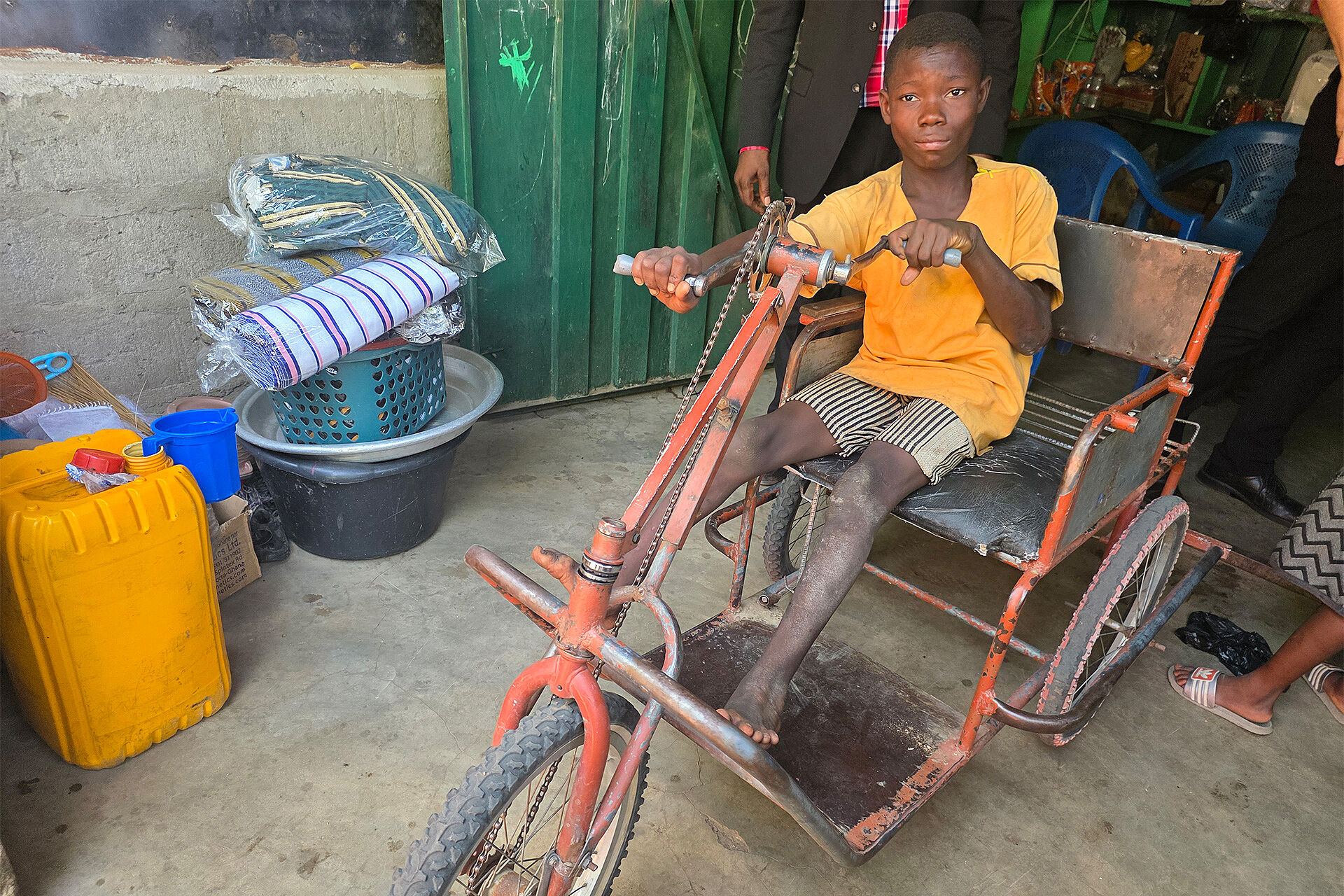
Morris Atengbiik Agoadem from northern Ghana has big dreams: he wants to become a nurse or a teacher. To achieve this, there is one thing he needs above all: education. But for many years, going to school was a huge challenge. Morris has cerebral palsy, which has left his legs paralysed. For years, he had to crawl to school, often spending up to two hours a day making the journey.
Today, things are very different. Thanks to a specially adapted tricycle that he can propel using his arms, Morris can now get to school independently and on time. This was made possible through a rehabilitation project run by the Presbyterian Church of Ghana and supported by the Evangelical Mission in Solidarity (EMS).
Morris and his mother Cynthia talk about their daily lives, the exclusion they have faced, their hopes and the new opportunities that have opened up for their family.
Morris, you now ride your tricycle to school every day. How does that feel?
Morris: It is wonderful! I can get to school on time now, and I can make the journey on my own.
What was it like before?
Morris: I had to crawl. That meant I was often late, and my school uniform was always dirty.
Cynthia, what was that time like for you?
Cynthia: It was very hard to watch my son struggle every morning. I often felt helpless. Sometimes I was afraid he might lose heart. But Morris was determined to learn and go to school.
You must provide for your family on your own. How did you manage?
Cynthia: I am a widow, and I support my children with what we earn from farming. Our income is small. I often prayed that our situation would change.
But you also took steps to find support yourself.
Cynthia: Yes. One day, I was invited to a self-help group for people with disabilities and their families. There, I met a staff member from the Presbyterian Church of Ghana's Community-Based Rehabilitation programme. He came to our home that very day, examined Morris and found that his arms were strong enough to propel a tricycle.
Morris, do you remember the moment you received your tricycle?
Morris: Of course! I was overjoyed and thanked God for it.
And where do you go these days, apart from school?
Morris: To the market, to visit my friends and to the well. I can even fetch water by myself now.
That has changed everyday life for your family.
Cynthia: Very much so. Morris used to need help with many things. Now he can do a lot on his own. He rides to the well, fetches water and gets himself ready for school. That gives me more time for my work and my other children. But the best thing is seeing how independent and confident he has become. He also participates more actively at school.
How are children with disabilities viewed in your community?
Cynthia: Many people have prejudices against them. Some even reject them. This is very painful for the families concerned. Mothers must bear the burden alone.
What kind of support do families receive through the rehabilitation programme?
Cynthia: There are assistive devices such as tricycles, crutches and orthopaedic braces. Parents learn how to help their children with movement exercises, relax their muscles through massage to relieve pain. There are also meetings where families can share their experiences. The women encourage one another and receive support in finding ways to earn their own income. This is particularly important because many of them can only work limited hours due to their children's care needs.
Morris, what would you like to be when you grow up?
Morris: A nurse or a teacher. I want to work and earn my own money.
Cynthia, what do you think of his plans?
Cynthia: I'm very proud of him. I hope he will be able to complete his education. For our family, education is the key to a better future. I will do everything I can to support him along the way.
What would you wish for other children with disabilities?
Cynthia: That they have the same opportunities as Morris. There are many children who want to learn and shape their own lives but lack the support they need. I am deeply grateful to EMS for the help our son has received. I wish the same for other families.
And Morris, what's the best thing about having your tricycle?
Morris: That I do not need help all the time anymore. Now I can just get on my tricycle and go!