
Thursday, 19. November 2026
Rima Nasrallah: Making Hope Tangible in Times of Crisis
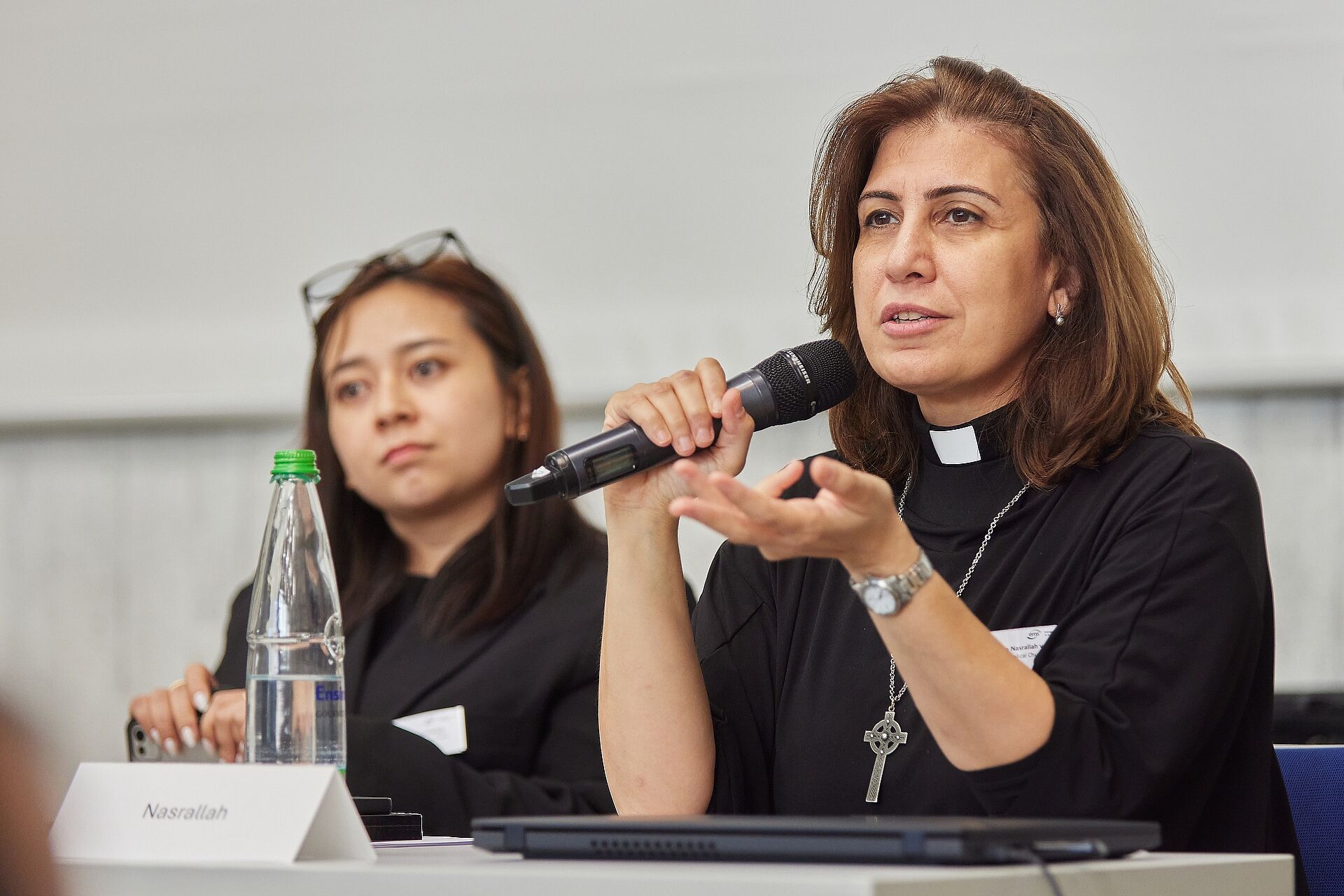
In a keynote address at the General Assembly of the Evangelical Mission in Solidarity (EMS), Rev. Dr. Rima Nasrallah urged delegates to become credible ambassadors of hope in a world marked by war, climate crisis, political instability, and profound social change.
Addressing delegates from Africa, Asia, the Middle East, and Europe, the Senior Pastor of the National Evangelical Church of Beirut (NECB), EMS’s member church in Lebanon, challenged Christians to move beyond words and sentiment. Christian hope, she argued, becomes visible through solidarity, practical action, and faith lived out in everyday life. At a time of mounting global challenges, Nasrallah called on churches to embody hope and carry it to places marked by fear, uncertainty, and despair.
Speaking on the theme "Ambassadors of Hope in a World in Crisis," she described today's challenges as an unprecedented convergence of interconnected crises and urged churches not to succumb to fear or resignation.
"Hope is not a comforting escape from painful realities. It takes suffering seriously and dares to believe that reality can be different", Nasrallah said.
Beyond Despair
Drawing on biblical perspectives and contemporary experiences from around the world, Nasrallah reflected on the different ways people respond to crisis. Some seek refuge in distraction, others lose hope altogether, while some pursue power and wealth at the expense of others.
Christian hope, she argued, offers a different path. Grounded in faith and expressed through action, it enables individuals and communities to face reality honestly while working toward transformation.
“Christian hope is not merely a feeling. To be ambassadors of hope is to embody it, to carry it into places of despair, and to make it tangible through our relationships, our solidarity, and our actions.”
The Courage to Imagine
A central theme of the keynote was the church's capacity to imagine a future shaped by God's promises. Nasrallah suggested that one of the greatest challenges facing churches today is not simply the loss of hope itself, but the loss of imagination that makes hope possible.
"Perhaps one of the greatest crises facing the church today is not simply that we have lost hope, but that we have lost the capacity to imagine what hope might look like", Nasrallah said.
She highlighted courage, perseverance, and imagination as essential dimensions of Christian hope, enabling churches to act even when circumstances appear overwhelming.
Learning from One Another
Participants were invited to reflect on signs of hope within their own communities and contexts. Throughout the General Meeting, delegates shared experiences from their churches and explored how hope is lived out in different regions of the world.
For Nasrallah, such exchanges are vital. In a time of global challenges, churches need one another's wisdom, experience, and encouragement.
Hope Lived in Solidarity
While responses to crises must emerge from local realities, Nasrallah emphasised that Christian hope is inherently communal and ecumenical.
No church, she argued, can address today's challenges alone. Instead, churches are called to accompany one another, learn from one another, and act together across geographical and cultural boundaries.
“The challenges we face exceed the capacities of any one church or community. We need to act together, each from our own context, while learning from and supporting one another.”
Faith, Hope and Love
Concluding her keynote, Nasrallah reflected on the biblical triad of faith, hope, and love. Hope, she said, draws its strength from faith in God's promises and finds its direction in love for others.
In times when hope seems fragile, faith and love sustain communities and enable them to continue their witness.
"Faith gives hope its foundation and love gives faith its direction. When hope falters, we turn to faith and love to find support", said Nasrallah.
As the highest decision-making body of the Evangelical Mission in Solidarity (EMS), the General Assembly plays a key role in shaping the organization’s shared vision, strategic direction, and public witness across Africa, Asia, Europe, and the Middle East. The Assembly meets from 19 to 21 November 2026 at the Protestant Academy Bad Boll in Germany.