
Thursday, 14. May 2026
“I want my children to believe in themselves”
How Anna Riana Arief gives deaf children in Indonesia a voice
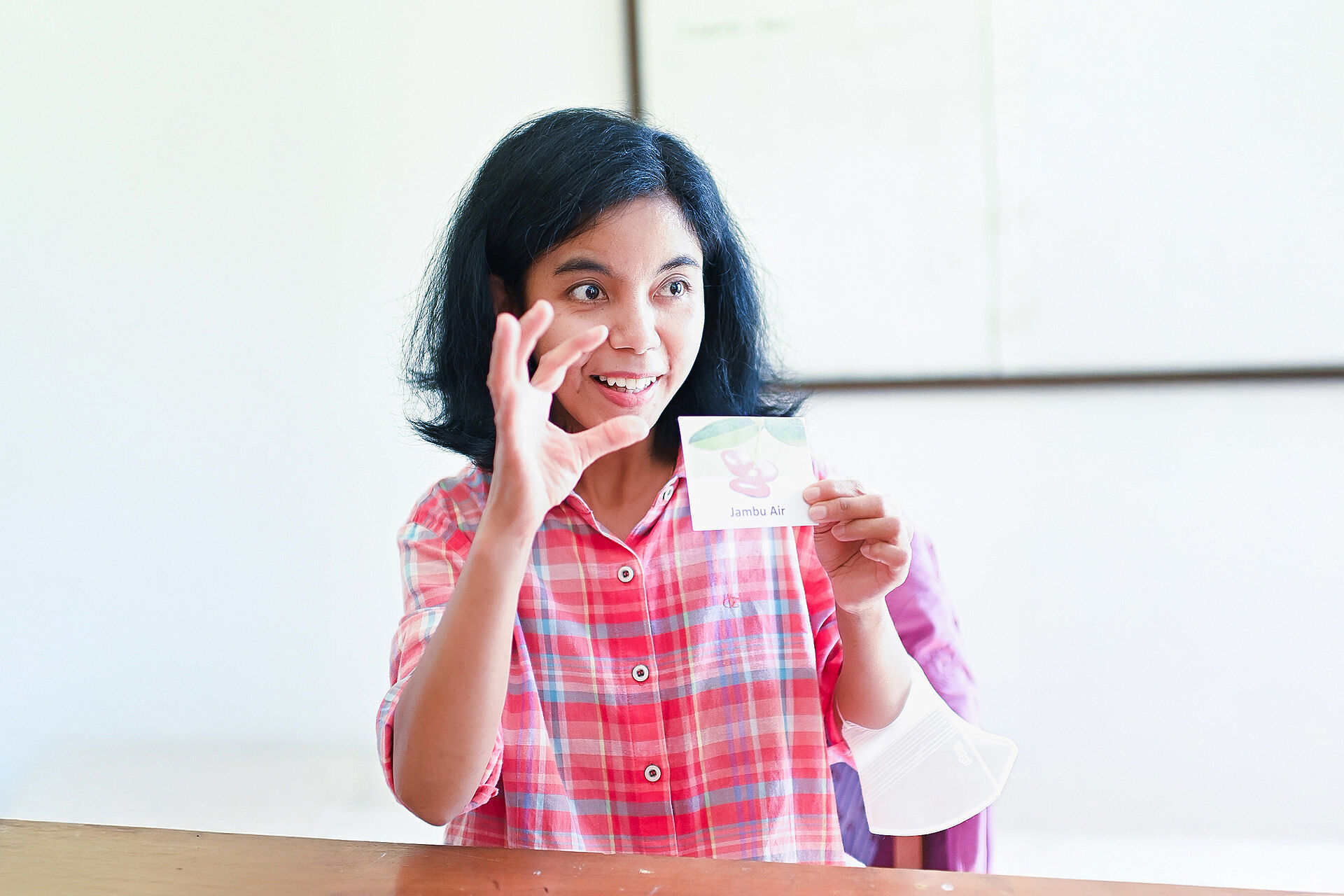
There is a lively atmosphere at the daycare centre in Rantepao as Anna steps into the bright rooms. Children reach out to her, their eyes lighting up as they greet her in sign language.
Here, in the heart of North Toraja, Indonesia, she teaches deaf and hard-of-hearing children – in the place where she once learned to navigate a silent world herself.
Anna lost her hearing when she was just a year old. Today, at 42, she works as a caregiver and teacher in the RBM project – Rehabilitasi Bersumberdaya Masyarakat, meaning “Community-Based Rehabilitation.” The centre, run by the Toraja Church, has been supported by the Evangelical Mission in Solidarity (EMS) for many years.
For Anna, RBM is more than a workplace. It is where her own journey began – and where she now gives children courage, guidance, and hope.
(In Indonesia, formal language is customary, especially in interviews. For this conversation, both sides agreed to use the informal “you,” reflecting the warm and open atmosphere Anna creates.)
Thank you for taking the time, Anna. Where did you grow up?
I was born in Rantepao, the capital of North Toraja. My mother is from Baruppu and my father from Sudu. My parents were always there for me. Even with limited resources, they gave me a wonderful childhood. It was not always easy, but I have many fond memories. My mother grew up Christian, my father Muslim, so I am familiar with both religions. My Christian grandmother, in particular, had a strong influence on me.
You lost your hearing very early in life. What do you remember about that time?
I actually hardly remember it. I was about one year old. My parents told me they took me to Makassar, where a doctor explained that a severed nerve cord had caused my hearing loss. It was only when I grew older that I realised I was different from other children. Making friends was difficult. Being understood was difficult, too. Sometimes I felt lonely – but I learned to cope.
When did you first come to the RBM Daycare Centre?
I was around twelve. My parents had heard about it at church. When I came here, I felt truly understood for the first time. I could express myself without feeling ashamed.
What did this place mean to you back then?
A great deal. RBM was a safe place for me. The caregivers treated me with patience and respect. They encouraged me – something that changed my life.
How did you become an RBM employee?
After many years at the centre, I realised I wanted to pass on what I had received. I started working here at 27, first as an assistant, then as a caregiver and teacher.
It felt natural. I knew this place. It meant so much to me.
What is everyday life like with the children?
Very lively! We laugh, we learn, and we grow together. What makes me happiest is seeing how the children become more confident. Many are very shy at first, but gradually they open up. Witnessing that transformation is wonderful.
Are there moments that touch you especially?
Yes. For example, when a child suddenly wants to sign in front of others for the first time, or when they proudly show that they can now do something on their own.
Those moments make me happy.
What role does sign language play in your work?
A huge one. It is the key to everything. Without communication, self-confidence cannot grow. I teach sign language and use it every day. It was not easy at first, but with training and support, I learned a great deal.
How does communication work in everyday life?
Most deaf people here use Bahasa Isyarat Indonesia – BISINDO –, the natural Indonesian sign language. We use it to play, learn, and talk. Then there is Sistem Isyarat Bahasa Indonesia – SIBI –, which is used in schools or official settings.
And how do you communicate with hearing people?
It depends. Most hearing people do not know sign language. We must often write things down – on paper or using apps. Without these tools, communication is almost impossible. Sometimes interpreters or volunteers help at government offices.
What are the biggest challenges for the children?
Becoming independent. Many of them dream of working in sewing, cosmetics, or running small shops. But they often lack the money or support. I encourage them and remind them of everything they can do. Our community helps a lot.
Do you see yourself as a role model?
Not really. I am simply someone who has had similar experiences. But my story shows that it is possible to find your own path – with patience, and with support.
Is there a project close to your heart?
I want my children to become independent. I want them to learn to read. I want them to find their place in society. For that, we need certain tools – hearing devices, a good SIBI dictionary for school, and other aids. And I have another wish: to take the children on a short trip. To leave everyday life behind. To laugh together. To create memories. I am sure they would love it.
You often speak of “my children.” Why?
(Anna smiles.) Because that is what they feel like to me. I see their fears, their progress, their joy – every day. Sometimes it feels as though they are my own.
What is the most important thing you have learned in life?
Patience, attentiveness, and that every bit of support matters. I have seen how encouragement can change a life. Today, I can pass that on. For me, that is the greatest reward.
Thank you very much for talking to us, Anna.
Thank you. And thank you to everyone who supports RBM. Without them, my journey – and the children’s future – would not be possible. I am grateful to my colleagues, too. They do a wonderful job every day. I am proud to be part of this team.
Interview and text: Thorsten Krüger