
Wednesday, 20. December 2023
A Blessed Christmas!
“Glory to God in the highest and on earth, peace and good will to all people“
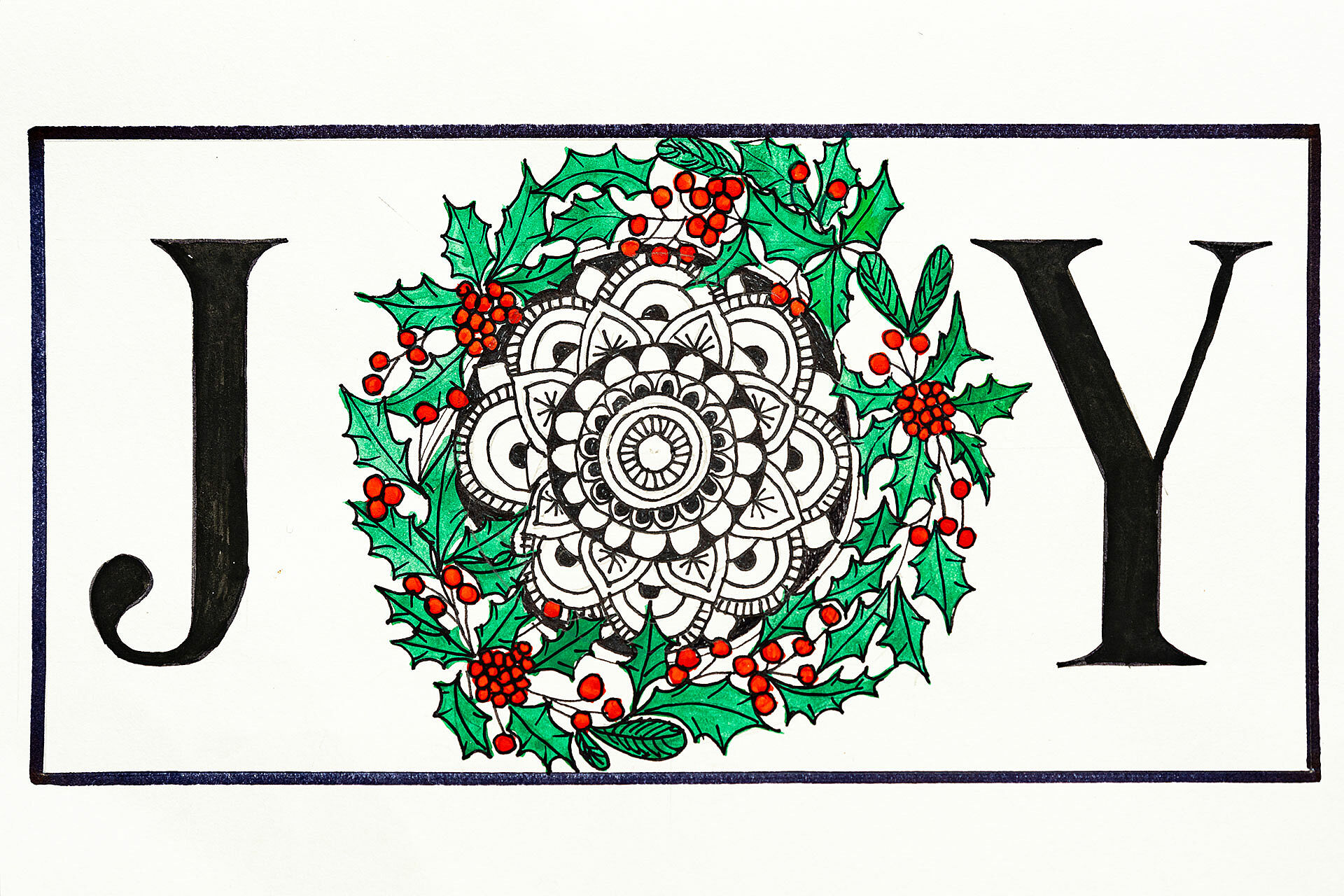
This year's Evangelical Mission in Solidarity (EMS) Christmas card was designed by Dr Satya Sudhir of the Church of South India (CSI). It combines the motif of the Advent wreath with the traditional Indian Kolam pattern. You can order the Christmas card in the EMS-Shop.
In India, a Kolam is a greeting of welcome and is a pattern drawn on the ground in front of a house. In Europe, the Advent wreath is a symbol of the joy of looking forward to Christmas. Interwoven, the two become a symbol of hope – God was made man to bring peace to the world.
We are very grateful for the encounters and your support for our work over the past year. We wish you a blessed Christmas and a peaceful New Year.

Dr Dieter Heidtmann
EMS General Secretary
J O Y - Contemplation on the Christmas card by Dr Satya Sudhir from South India
We are all familiar with the Christmas narrative as told to us in the Gospel of Luke: Jesus was born in a stable and was laid in a manger. The first witnesses of this redemptive event are shepherds. An angel appeared to them near the stable in Bethlehem where they were tending their sheep. As the angel spoke, their fear was dispelled and joy returned.
And suddenly there with the angel was a multitude of the heavenly host, praising God and saying, ‘Glory to God in the highest heaven, and peace among those whom he favours!” (Luke 2:14 NRSV) Yes, praise be to God and yes, let there be peace! In view of the present global political situation, we wish for nothing more. But who are the people whom God favours? Is the message of peace and salva-tion in the Christmas story only destined for a certain group of people? Or to turn it the other way round: are there certain people who are excluded? Hardly. The message of Jesus' birth is meant for everyone. God's love is unconditional. God's love is boundless.
Our Christmas card is all about joy. The letters of the English word J O Y stand for Jesus - Others - You. This is the way the Indian artist interprets her work. She transcends borders. Her Christmas greeting combines the western culture of the Advent wreath, here the typical green and red of holly at Christ-mas, with a kolam from South India.
A kolam is an artistic design created on the ground in front of a house. All the dots, lines, curves and loops go to form a symmetrical pattern. It is a greeting of welcome, a very all-encompassing welcome. In fact, the rice flour traditionally used is eaten away by ants, birds and small crawlers over the course of the day. The kolam is said to drive away evil spirits and attract good spirits into the house. It sym-bolises the harmonious coexistence that is expressly desired here, including between humans and animals. Over the course of the day, a kolam gradually disappears – it gets blown away by the wind or dispersed by the rain. However, every morning, after the entrance area has been cleaned, a new kolam is made; and of course, on public holidays there are extra special ones.
How beautifully Indian and Western traditions complement each other in the artistic expression of Christmas joy: the invitation of the South Indian kolam to enter the house blends in with the western Advent wreath tradition. The lights of the Advent wreath help us realise with all our senses that, as each week passes, the light grows brighter until we finally see "the light of the world" with the birth of Jesus and experience the joy of God's love for us humans. The shape of the kolam and wreath empha-sise the idea that the whole earth is invited to this light - an eternal offer made to us time and time again.
At its centre, the word J O Y contains the round “O” representing the kolam circle and the round wreath. It stands for Others and it is flanked by “J” for Jesus and “Y” for “You” – that is to say you and I, each and every one of us and all of us together. This makes the card into a strong message against anything marginalising and exclusive. The “Others” are in the middle. So, any attempt at “othering” is met with a resounding “No”. Quite the contrary: the "others" belong in our midst, they are welcome and gladly received. In the yearly nativity scene, the figures of Mary, Joseph and the baby Jesus, the shepherds, the wise men, the ox and the donkey are a reminder of this. Together, inviting, spreading the joy and light of Christmas - this is exactly who the heavenly hosts sing about: the people whom God favours. Together we can recognise God's love and together our commitment should be devoted to creating peace on earth.
Dr Kerstin Neumann
Head of Department Programmes and Networks