
Tuesday, 24. February 2026
Living Dialogue
Four Voices on Interreligious Learning Across Continents
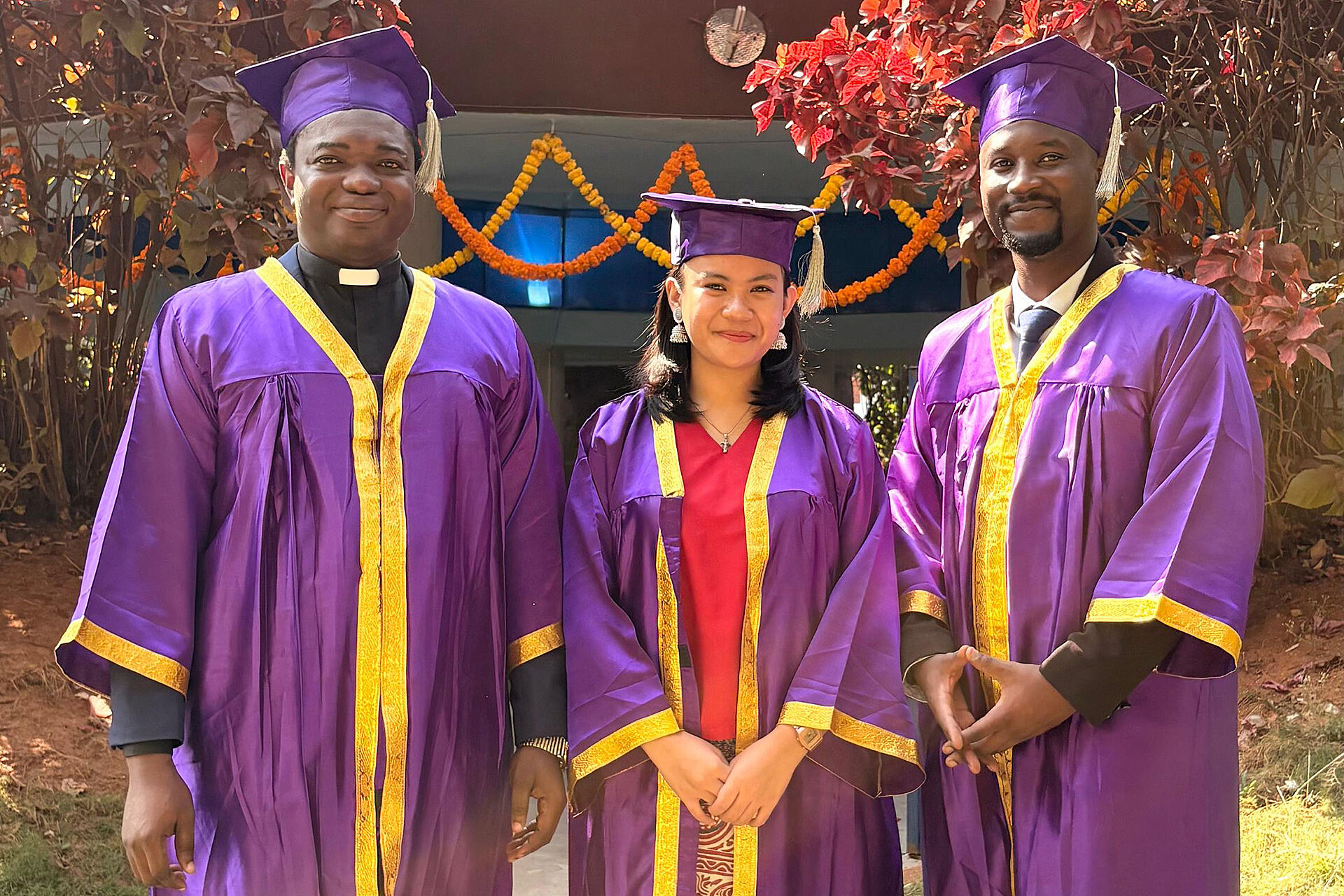
In a world that is both interconnected and polarized, interreligious dialogue has become more than an academic discipline – it is a lived practice essential for peaceful coexistence. Through a sixmonth Interreligious Studies Programme at the Henry Martyn Institute (HMI) in Hyderabad, India, the Evangelical Mission in Solidarity (EMS) fosters this kind of transformative learning.
Four participants – Putri Adelia Datu Manaek Sampebua (Indonesia), Rev. Joseph Charles Kwaatei Quartey (Ghana), Liviwe Masizole Ndabambi (South Africa), and Edward Daniel Simamora (Indonesia) – share how the programme shaped their understanding of faith, identity, and community.
Understanding between faiths is vital for global peace
For each participant, the decision to join the programme emerged from personal conviction and curiosity.
Putri, raised in Indonesia’s vast religious diversity, explains: “I want to learn to understand, not merely to know, and I want to engage other religions dialogically and constructively.”
For Joseph, who was already active in ecumenical and interfaith work in Ghana, the course promised a broader horizon: “I believed the course would help me appreciate other religions, especially outside my country. Understanding between faiths is vital for global peace.”
Liviwe entered the programme driven by a theological calling: “If our witness is to be valid, it should bring about peace and reconciliation. We cannot be a divided Church in a divided society.”
Edward, a researcher and academic editor, sought to expand his academic and theological framework: “My primary motivation was to deepen my understanding of interreligious dialogue beyond the Indonesian context, especially through South Asian perspectives. HMI’s blend of thorough study and lived engagement offered exactly that.”
Living and studying in India
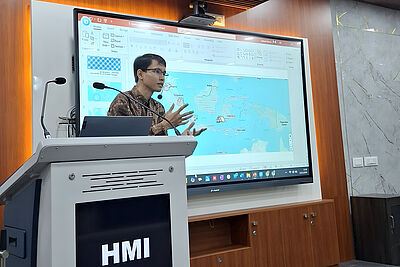
Living and studying in India – a profoundly pluralistic society – shaped each participant in unique ways.
Joseph was struck by how dialogue was woven into daily life: “People from different faiths study, live, work, dine together and respect one another – not just as a programme but as a lifestyle.”
For Liviwe, entering others’ sacred spaces strengthened his understanding of hospitality:
“Being a good guest means leaving your comfort zone and being respectful while grounded in your faith.”
Putri experienced transformation not only through lectures but through shared humanity: “Simple moments – sharing meals, family stories, conversations after class – taught me the true meaning of dialogue.”
Edward was moved by India’s internal diversity – linguistic, cultural, religious – which challenged his assumptions of a monolithic “Asian” identity. Discovering that Jesus has a respected place within Islamic theology became a particularly profound learning moment for him.
Interreligious realities differ across contexts
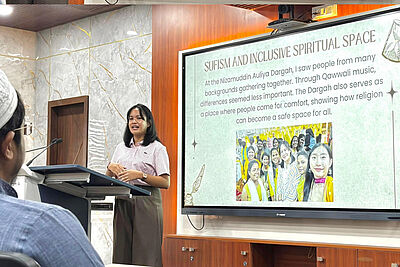
Putri reflects that diversity requires “maturity in faith, openness, and a commitment to peace.” In Indonesia, she sees plurality as an inseparable part of cultural and social life.
Joseph describes Ghana as a country where religious groups coexist naturally – celebrating festivals together and navigating differences with generally peaceful coexistence.
For Liviwe, diversity is rooted in shared humanity: “Our identity should be that we are all human beings, living together with kindness and humility.”
Through a decolonial lens Edward appeals to humanize fellow human beings: In Makassar anthropology, humanity itself is defined by pacce – a “devastatingly beautiful paradox” where honour and pain exist simultaneously. “The honour in me exists if I can see your suffering as mine. This is what makes me human,” Edward explains this concept. Coexistence, therefore, transcends mere tolerance; it is a radical solidarity dictating: “I don’t want to go to the light at the end of the tunnel if it means leaving my fellow behind.”
Bridgebuilding in churches
All four participants see the programme as essential preparation for leadership and community engagement.
Liviwe believes it strengthens his responsibility as a future church leader: “Theology must move beyond the classroom and be visible in the lived experiences of the general public.”
Putri hopes to embody reconciliation in her ministry: “I am encouraged to become a bridge that embodies interfaith cooperation.”
Joseph feels renewed confidence as he continues his work in Ghana: “The programme has helped me break prejudice and fear. This will help me relate freely with people of other faiths in my country.”
Edward’s perspective on conflict transformation has been profoundly reoriented. His encounters – including studies at the Center for Peace and Spirituality in Delhi – introduced the idea that reconciliation can (and sometimes should) precede structural justice. He plans to integrate these nuanced insights into his ministry, activism and research on public theology and collective trauma, serving as an intellectual and spiritual bridge between divided communities in Indonesia.
A programme to be recommended
All four participants wholeheartedly recommend the Interreligious Study Program at HMI.
Joseph affirms: “HMI is the best place for anyone interested in interfaith study.”
Putri adds: “This programme enriches academic insight and cultivates social sensitivity and spiritual depth.”
Liviwe highlights its safe and transformative space: “It deepens your faith while empowering you to seek understanding and inclusivity.”
Edward emphasizes the programm’s unique academicpractical integration: “HMI forces a meaningful encounter between text and context. It is ideal for anyone who wants not only to understand the ‘why’ of interfaith dialogue but to practice the ‘how’.”
Across continents, cultures, and languages, their stories converge on a shared insight: Interreligious engagement is not merely intellectual – it is relational, humble, transformative, and urgently needed in today’s world.