
Tuesday, 19. November 2024
Love of One’s Neighbour as Social and Political Transformation
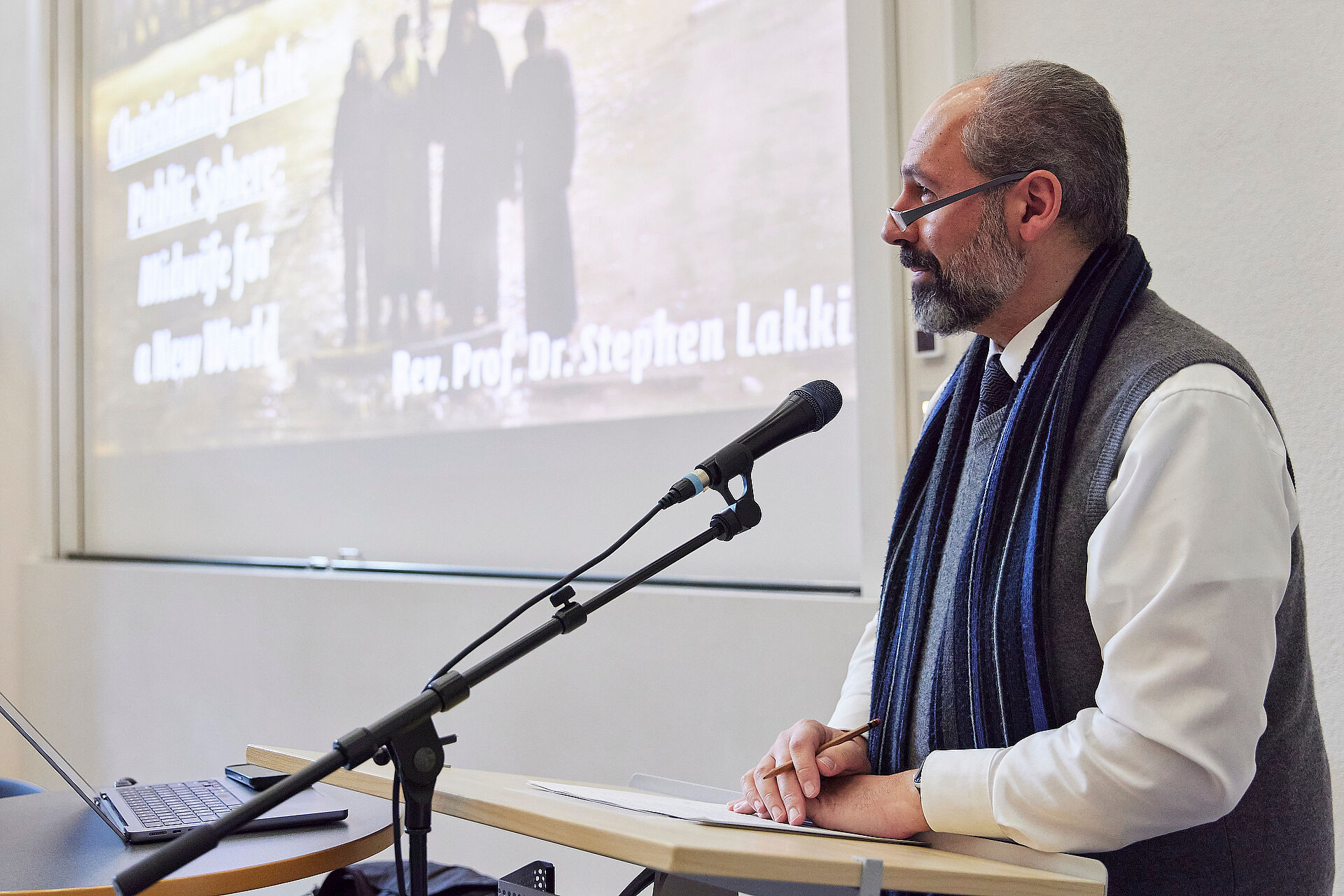
Dr Stephen Lakkis speaks at the EMS General Meeting about the public nature of faith.
The international delegates of the Evangelical Mission in Solidarity (EMS) gathered for their General Meeting in Freiburg in Baden on 13 to 16 November. Besides taking important decisions, they also discussed the topic of “the public nature of Christian faith”. They agreed that the world needs Christianity as a publicly influential force for good. Especially because individualism and self-withdrawal are on the rise.
Stephen Lakkis, pastor and professor of public theology from Pforzheim, rejects the idea of a “public theology” as a separate branch of theology. All sound Christian theology and the Christian faith are public per se: "In the Christian tradition, there is hope for transformation, for personal as well as social transformation. By speaking out for justice and directing our energies towards this transformation, we Christian midwives are bringing the kingdom of God into our world now.” The theologian had been invited as a keynote speaker to the General Meeting in Freiburg.
Stephen Lakkis emphasises that love in the meaning of “agape” is a method of achieving the Christian aim of personal, social and global transformation. "Jesus did not ask us to love him, but to pass on his love to the people around us," he explains. ’We show our love for God by taking part in the social and political action of love towards our neighbour. This means that the Christian faith is inherently social and public."
The worldwide commitment of the EMS Fellowship is precisely the kind of public faith that Lakkis emphasises in his lecture. In South Korea, the Protestant Church of Korea (PROK) provides a wide range of support services for first and second-generation migrants. Migration is a recent phenomenon in South Korea. The Moravian Church in South Africa is committed to rectifying historical injustices related to land ownership. They support those who, after experiencing dispossession in the first half of the 20th century, are now asserting land claims. These are just two examples of EMS member churches from the wide-ranging portfolio of EMS initiatives. "Christians are called to be a sign in today's world of what God intends for all humanity. And we must not fail in this," stresses Rev. Andrew Odjawo. The Presbyterian Church delegate from Ghana was elected to the EMS Presidium at the General Meeting.
The Evangelical Mission in Solidarity (EMS) is an international association of Evangelical churches and mission societies and represents the concerns of around 25 million believers in Africa, Asia, the Middle East and Europe. All the members of the EMS have equal rights and work together on an equal footing.
Press contact: Dr Dieter Heidtmann, heidtmann@ems-online.org, Tel.: +49 711 636 21, Mobile +49 178 6367836