
Thursday, 12. February 2026
Through Lent with EMS
Walking with Jesus and Our Questions

In the weeks leading up to Easter, Christians around the world embark on a spiritual journey: the journey of Jesus to Jerusalem. At the end of this journey stand the cross and the resurrection, which are at the heart of the Christian faith.
As it is written in chapter 9, verse 51 in the Gospel of Luke: “As the time approached for him to be taken up to heaven, Jesus resolutely set out for Jerusalem.”
The Way of Jesus: Encounters, Stories and Challenges
According to the evangelist Luke, this journey was full of encounters, conversations and experiences. Jesus does not travel alone. People accompany him, ask him questions, and approach him with their troubles and hopes. He spends time with them, offers words of encouragement and admonishment, and leaves behind stories that invite reflection.
Women often play an important role in these accounts, appearing confident and resisting injustice. At the same time, some men show uncertainty at decisive moments or withdraw.
The biblical stories speak of power, courage, exclusion and solidarity — and thus also of issues that are still relevant today.
Reflections by Young Theologians on Gender and Justice
During Lent, this journey is to be rediscovered together. Seven young theologians will offer short weekly reflections on Instagram and Facebook. Reading these familiar texts with open minds, they ask: what resonates with us today? What emotions, experiences and structures emerge? What can these stories teach us about community, justice, and role models?
This includes questions of gender and justice. At EMS, we are committed to a world in which people can live free from discrimination and violence, regardless of their gender or sexual orientation. That is why we deliberately examine the traces that the biblical texts leave in this regard. Where are people empowered? Where are they excluded? What does this mean for our churches and society today?
Join us on this journey through Lent and into Holy Week. Discover inspiring reflections on Instagram and Facebook that move the heart, challenge and encourage.
7 Theologians, 7 Impulses

Lk 9,51-61
During Lenten Season, seven young theologians connected to EMS will share short, fresh and thoughtful reflections close to everyday life.
Theologian Joscha Quade, who is responsible for third-party funding at EMS, will kick things off by reflecting on Luke 9:51-61 and asks: "Should I stay or should I go?"
Jesus sets out on the path to Jerusalem, leaving much behind. Not everyone follows him; some stay behind out of fear or habit.
But Jesus keeps going. He closes the door behind him. Turning back is not an option. Ahead lies a challenging path. He is not welcomed everywhere; sometimes he is 'too different' and disrupts the routine.
Many people face similar decisions: whether to stay or leave, be it in work, relationships, during a crisis or in our congregations. Often, the choice is not entirely free.
I hope for a church that offers an open refuge to people on their life's journey – a place where nobody is turned away for 'being disruptive' or 'not fitting in'. A space that encourages and empowers people. Since even Jesus would have needed such a refuge.
Joscha Quade
Theologian and responsible for third-party fundraising at EMS

Lk 15,8-10
During Lenten Season, seven young theologians connected to EMS will share short, fresh and thoughtful reflections close to everyday life.
Marie Raschner, vicar of the EKKW, refers to a parable told by Jesus, focusing on what appears to be lost yet is of infinite value.
When Jesus eats with those whom others call “lost”, it provokes criticism. He responds with an image: a woman loses a silver coin. She still has nine left, yet she does not say, “That's enough.” She searches persistently, lighting a lamp and sweeping thoroughly until she finds what is missing.
I believe this image tells us something about God: in a world where women often remain invisible, Jesus tells the story of a woman. God's love is revealed through devotion, care, and patience – every person is valuable and counts.
I dream of a church where people feel valued, where their questions and concerns are acknowledged, and where no one is overlooked. God seeks, and I wish that we would seek one another too: in the church, in society and in our private lives. Everyone counts.
Marie Raschner
Substitute Pastor, Evangelical Church of Kurhessen-Waldeck (EKKW)

Lk 18,1-8
During Lenten Season, seven young theologians will share short, fresh and thoughtful reflections close to everyday life.
Sarah Hilmer, a church history doctoral student at Georg August University in Göttingen, considers an emotion that is not usually considered to be pious:
anger A widow repeatedly approaches a judge. He does not listen to her, only taking care of her concerns when she becomes a nuisance – not because he is interested in justice.
This judge makes me angry. His indifference seems frighteningly familiar. The widow, on the other hand, remains persistent. She does not allow herself to be discouraged and demands her rights.
Her anger is a driving force for change. As the many pioneers of women's rights have shown us, many changes begin when people no longer put up with everything.
International Women's Day, which is cpming up soon, reminds us of the ongoing struggle for equality. Even today, there are many unheard voices that deserve to be heard.
Sarah Hilmer
PhD candidate in Church History at the Georg August University of Göttingen
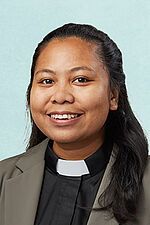
Lk 21:1-4
During Lent, seven young theologians share short reflections – fresh, thoughtful, and close to life.
Pastor Junita, Deputy Chair of the EMS General Assembly, focuses on the theme of deprivation in Luke 21:1-4.
Jesus highlights the widow’s offering: much had already been taken from her – her social status, economic security, and future – yet she gave wholeheartedly from the little she had left.
He acknowledges this profound sacrifice and points to his own. He identifies with all who have experienced exploitation, oppression, and marginalization – then and now.
From this story, I learn that faith is not just about material giving, but about solidarity with those who live in suffering and limitation.
My hope for the church today is that those with worldly privileges will stand willingly alongside the needy and commit themselves to their well-being.
Rev. Junita
Vice-Chairwoman of the EMS General Assembly

Lk 22:39–46
During Lent, seven young theologians will share short, fresh and thoughtful reflections on everyday life.
Pastor and Schoolcounsellor Philipp Häge reflects on Gethsemane (Luke 22:39–46), where Jesus prays and faces his fears. It is night. The walk home is long. I hide my hands.
In the queer nightclub, like-minded people admired my painted fingernails. Out here, however, I am afraid of being recognised by the wrong people because of them.
My friends are unfamiliar with this feeling. They are white, straight and male. They don't need to worry on their way home.
Yet I still feel insecure, even in their company. I question my decision to paint my fingernails as a man. My hands tremble in my pockets. So I pray.
I pray to the One who knows my fear. He experienced fear Himself in the Garden of Gethsemane, and knows what it feels like to be surrounded by friends who do not understand it. Praying helps. It calms my soul. It carries me safely home — at least this time.

Lk: 22:54-62
During Lent, seven young theologians will share brief reflections.
Thomas Houba, a pastor in the EKHN, considers Luke 22:54-62, in which Peter denies Jesus and fails himself.
Peter is certain: “I am ready to go with you to prison and to death.” But his bold promise is nothing but hot air. He denies Jesus three times. A classic case of male overconfidence.
Four out of five young people killed in road accidents or by drowning are male. This is no coincidence, but the result of male competition to be seen as strong, courageous and willing to take risks.
Peter is my favourite biblical character because he reveals so much human depth. He weeps bitterly. He shows that a man needs not present himself as stronger than he is. Certainly not before God.
New answers are needed to address current questions about masculinity. Then there will also be fewer road deaths. New images of masculinity that move away from the idea of strength are needed. A realistic self-image is a start: men cry.

Lk: 23:49, 55f.; 24:1–3, 10 ff.
During Lenten Season, seven young theologians will share short, fresh and thoughtful reflections close to everyday life.
Rev. Anna-Katharina Diehl, a PhD candidate in Intercultural Theology, focuses on the role of women as witnesses and asks a question that continues to resonate today: “Who is heard, and who is believed?”
The women around Jesus were very close to him. They followed him and his teachings during his lifetime and were with him at the time of his death and resurrection.
They were present when Jesus was crucified. They were the first at his empty tomb. There were several of them.
Yet, despite having seen everything with their own eyes, the apostles did not believe them.
Why? Because they were women?
How often are women's words not heard or believed? Let us listen to them! In the Church and everywhere! They might just have some good news!