
Wednesday, 21. October 2026
“We Hope Despite the Situation”
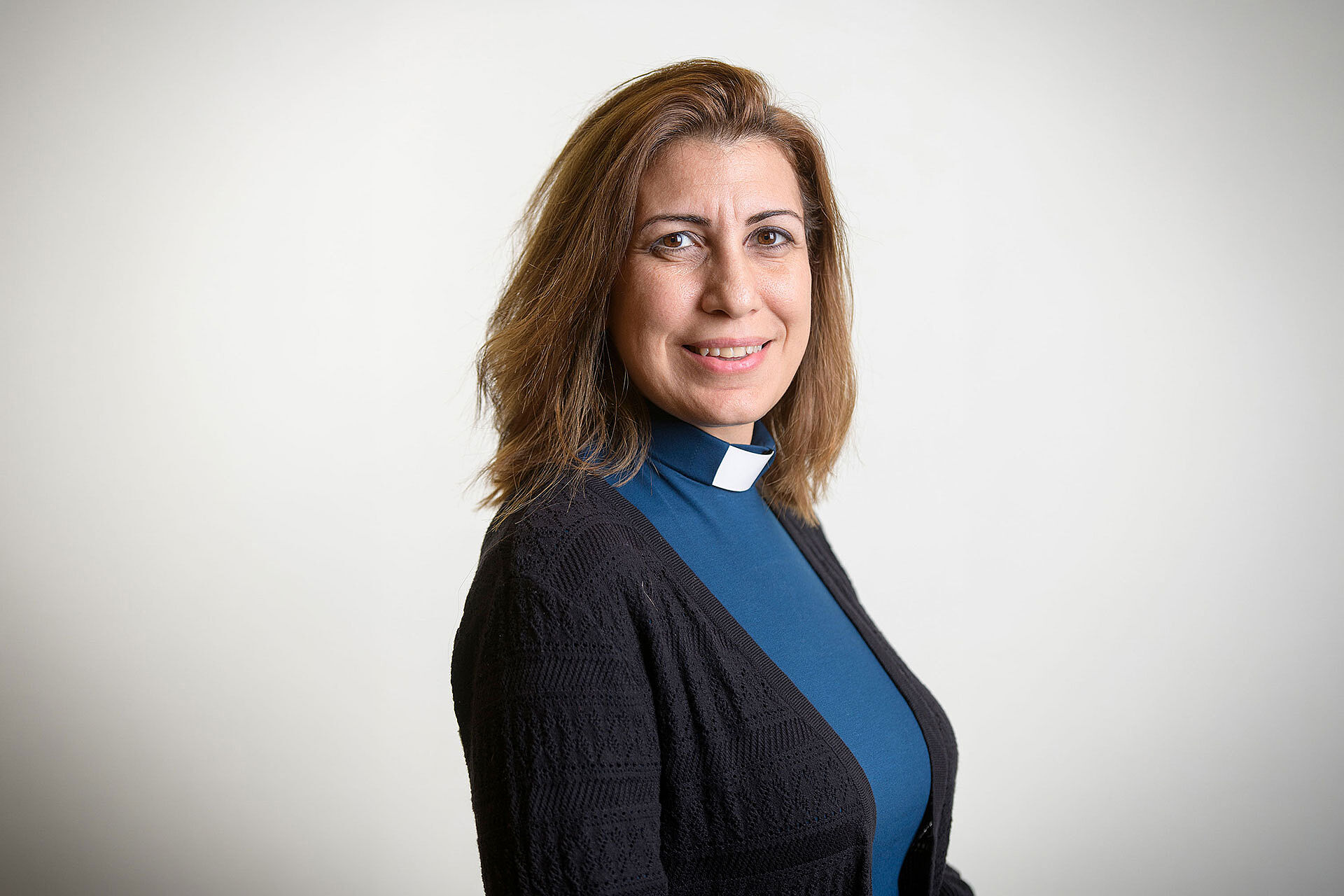
Rev. Dr. Rima Nasrallah on pioneering leadership, community building, and the role of the church in Lebanon’s uncertain times.
Rev. Dr. Rima Nasrallah van Saane was installed as Senior Pastor of the National Evangelical Church of Beirut (NECB), a member church of the Evangelical Mission in Solidarity, on 28 June.
As the first woman to be ordained and later appointed Senior Pastor the NECB, she has become a pioneering figure in Protestant church leadership in Lebanon and the wider Middle East. Her election comes at a time of profound challenges for both church and society, marked by economic crisis, political uncertainty, migration, and the lasting effects of conflict.
In this interview, she reflects on changing perceptions of women's leadership, her vision for the future of the NECB, the church's role in fostering healing and resilience, and the enduring power of hope amid adversity.
In 2018, you became the first woman ordained as a pastor in the National Evangelical Church of Beirut (NECB). Today, you are the first woman to serve as its Senior Pastor. Looking back on this journey, what has changed in the church's understanding of women's leadership over the past eight years?
Since my ordination in November 2018, much has changed in the perception of women in a clerical role both inside our church and in the ecumenical context. For our church, every step on this road was a first: Celebrating communion, officiating at weddings, baptizing children and accompanying families during funerals. It took time for the average church member to feel secure that these pastoral and sacramental moments are as trustworthy and valid when performed by a woman. This was even more challenging when these pastoral moments involved non-Protestants and those attending often felt shocked by the gender of the pastor. However, with time trust was established and though the surprise element is still there in public events, the general reaction is very positive, and people are starting to appreciate the different style of leadership.
Your appointment has been widely welcomed, but it has also prompted debate in some circles. How do you engage with those who remain hesitant about women in pastoral and church leadership roles?
There are many who still oppose the ordination of women and their spiritual leadership. When the grounds are theological and based on a certain hermeneutics, I can only respect the difference and clarify that we each start from a different understanding and manner of interpreting the scriptures. As for those who base themselves on socio-cultural considerations, their hesitation is an incentive for me to show a more faithful performance that can convince through action and teaching. But I am also resigned to the fact that this is a debate that will not end soon and that there will always be public criticism and opposition. As long as I am serving to the best of my knowledge and ability, I do so with trust and confidence.
Beyond the church itself, do you see your election as having a broader significance for women in Lebanon and the Middle East? What message would you hope it sends to younger women considering leadership roles?
I truly hope that my ministry will inspire young as well as more mature women to respond to God’s calling in their lives and to be encouraged to find their place in church and society at large. I know that my election has encouraged many of my previous students at the Near East School of Theology for whom such roles where unthinkable. I pray though that the way I live and practice this role will also help create a new model for leadership that is not only a replica of what men have done so far.
Your predecessor, Rev. Dr. Habib Badr, shaped the NECB for more than four decades and guided it through periods of war, reconstruction, and profound social change. What aspects of his legacy would you like to build on, and where do you hope to lead the church in new directions?
I have learned a lot from Rev. Badr. He was my teacher in seminary, and I have worked closely with him for years. He has instilled in me a deep appreciation for ecumenical relations, for tradition and for history. I have also learned from his tolerance and acceptance for others, and I have watched him practice radical generosity. These are values I would like to carry with me.
Going forward, I would like to focus on community building and leadership sharing. The location of the church and the situation in the country had negative effects on the cohesion and growth of the community. I would therefore like to focus on creating opportunities for education, sharing and spiritual growth in order to empower the members of the church and community at large so that they can in turn carry each other and guide our institutions.
I am very much interested in young people and in listening to them and giving them a voice and a place. For this I hope to activate our digital ministry, diversify our liturgical offerings and introduce new forms of music and faith expressions.
Care for creation is a topic that I hold close to my heart and passionately pursue. In my ministry, I pay special attention to this field in liturgy, teaching and practice.
The NECB is at the heart of a union of churches spread around Lebanon and yet negatively affected by years of displacement and war. It is my desire to foster greater cooperation between our churches and revive our Protestant presence in the rural areas.
Moreover, I am keenly aware of the growing NECB diaspora and hope to find creative ways to remain connected to our members abroad and serve their spiritual needs.
These are aspects of the ministry I hope to focus on, whether this will lead to new directions is still to be seen.
You assumed leadership at a time when Lebanon continues to face economic hardship, political uncertainty, and the effects of regional conflict. What do you see as the most important challenges and responsibilities for the NECB in the years ahead?
In a region where the Christian community is shrinking and emigration is increasing, as NECB we need to rediscover our sense of calling and activate our role in society in ways that are sustainable and effective. Faced with multiple challenges for a prolonged period, the community is sometimes tempted to focus only on survival. And yet the needs around us are increasing: financial, social, and educational. And the role we can play in promoting peace, fostering human dignity and creating communities of love is becoming more vital.
I am aware of the great financial challenges facing us and the lack of human resources to accomplish the tasks ahead. But I believe that we should think creatively, and work collaboratively, in order to continue and expand the way we serve those around us and connect with those who have emigrated.
War, displacement, and loss leave deep emotional and spiritual wounds. In your experience, how can churches help individuals and communities move from trauma toward healing and resilience?
Healing comes from connection and purpose. The past decades have pushed around and dispersed the Lebanese inside Lebanon and outside of it. Wars have uprooted families, destroyed villages and caused irreversible change to patterns of life and traditions. As a church it is our role to create community, to connect people to each other and to God. Church becomes a home when home is no longer accessible; a safe place. The Church creates rhythm and reliability in a world that is unreliable and unstable. Moreover, the church and its institution can instil a sense of purpose and mission in the hearts and minds of those for whom life had become futile and worthless. When involved in something larger than us in God’s large vision and care, one’s own problems are relativised and the burden lessened. When getting involved in aiding those who need it, one’s own suffering is transformed into a healing power for others.
“Rest for the Weary” is an EMS-supported initiative addressing gender-based violence and promoting gender justice. What are the project's main goals, and why is this ministry particularly important in the current Lebanese context?
“Rest for the weary” came as a response to the experience of a number of women in the community in Beirut who have grown tired! Tired of the situation of war and anxiety, with its fears and uncertainties for over 5 decades. They are tired of trying to meet daily challenges of lack of electric power, water and failing infrastructure. They are tired of worrying about both one’s aging parents and growing children in a context of financial crises and with no support. And above all tired of battling gender barriers at work and home and social expectations that weigh women down. The initiative is there to help a group of women to find rest, to create a community of support and to learn skills that can help them heal and empower the women in their contexts.
Hope is a recurring theme in Christian faith, yet many people in Lebanon are living through prolonged uncertainty. Where do you see signs of hope today, and what gives you confidence for the future?
Hope is a gift given to us by the Holy Spirit just like love and peace. And one has to open oneself to it by accept this God given gift. In Lebanon, we have learned like the Psalmist not to put our trust “in princes, in human beings, who cannot save.” (Psalm 146:3), nor in institutions and promises. And therefore, we hope despite the situation and not because of signs and events. This hope requires trust that the world is held by God and loved by God despite all that we humans do to each other. One lives this hope by choosing to go on and conduct life in the midst of war, ruins and disasters and not wait for those to finish.
In our church community, we have learned not to let any external threat and challenge stop us from holding prayer services, continue with our ministries, and finding life’s joys amid trouble. We have learned not to have big expectations and plans as all those can collapse at any moment, but to trust in God and do all that is possible at the moment and relevant for those around us – because with God all things are possible.