
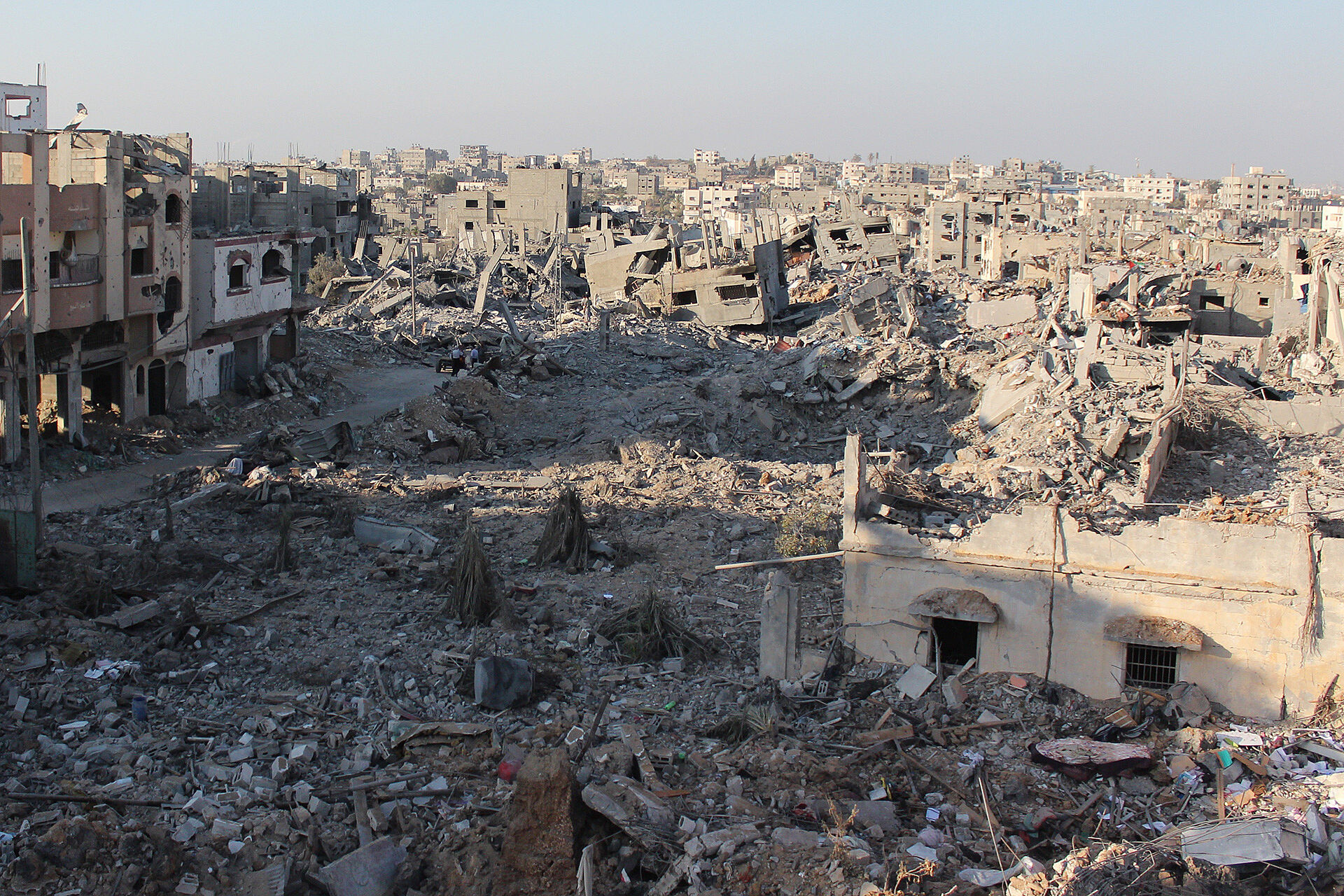
How will we ever be able to talk to one another after this cataclysm ends? Once the present maelstrom of terror, war, violence and hatred in the Middle East has come to a stop; once our ideological proxy wars on Europe’s streets have abated; once all that is left are ruins – ruins of destroyed homes, destroyed lives and destroyed souls – how can we ever look one another in the eye again?
For one of our EMS member churches, this war, which began with Hamas’ inconceivable terrorist attack on Israeli children, parents and grandparents on 7 October, is not a remote fantasy. The Episcopal Diocese of Jerusalem runs the Anglican Ahli Arab Hospital in Gaza. By the end of October, this facility had been hit twice by rockets. On Saturday 14 October, it was an Israeli missile that severely damaged the brand new cancer diagnosis department, wounding four staff members. And on Tuesday 17 October, it is fairly certain that it was a misfired Islamic Jihad rocket that exploded over the hospital‘s inner courtyard, killing many people who had sought refuge there. The director of the only Christian hospital in Gaza, Dr Souhaila Tarazi, has survived five wars here. This one is by far the worst.
The EMS Fellowship is also affected by the current catastrophe in other ways. Many young volunteers who were forced to leave Israel and Palestine had to travel through Jordan and the Theodor Schneller School there. Due to the economic and political crisis, the boarding home of the Johann Ludwig Schneller School in Lebanon is already full to capacity with children and young people from very poor backgrounds – now missiles are striking not too far away; Lebanon is being gradually drawn into the war. Our theology students, who were sent to the Near East School of Theology in Beirut (NEST) by the EMS, had to interrupt their academic year due to government travel advisories.
After this war, will our Palestinian partners still be able to speak with any impartiality to leaders of German churches who have publicly announced their exclusive commitment in their statements “We stand with Israel!”? And vice versa: Will Jewish Israelis still want to continue a dialogue with Christian partners who have played down Hamas’ terror and fantasies of annihilation against the Jewish state as a consequence of Israeli occupation? Centuries of murderous anti-Semitism do not need an occupation to justify its hatred – it will always blame “the Jews” or the Jewish state for all misfortune. Just as the fight against anti-Semitism is a constant challenge, the other challenge is to finally find more intelligent solutions to Israel’s security problems after this war than locking up an entire population. The deeply traumatised people of Gaza need opportunities to development, respect for their human rights and well-defined prospects that have been denied them for far too long.
As an international EMS organisation, we stand together in such situations of crisis. We pray for peace in Israel and Palestine, for our brothers and sisters on the ground and especially for those at the Ahli Arab Hospital. A particularly impressive sign of solidarity came from the Presbyterian Church of Korea (PCK) at the end of October. They donated a sum of €20,000 which has been channelled through the EMS to the hospital in Gaza. At the same time, our Korean brothers and sisters are calling for people to pray for Israel and Palestine. Perhaps we will succeed in maintaining good relations with all sides in this conflict and making a contribution to peace, at least within the EMS Fellowship.
Dr Uwe Gräbe
Head of the Middle East/EVS Unit at the EMS
Note: This comment refers to the situation in the Middle East at the time of publication of the text in "EMS Insights" at the end of November 2023.