Friday, 15. January 2021
Practising Solidarity in Difficult Times
EMS approves funds totalling €3.04 million for joint projects
- Issues
- »
- Solidarity + Partnership
- Press Releases
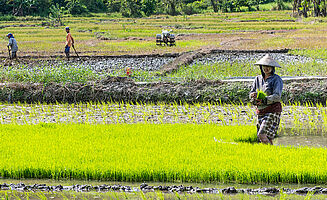
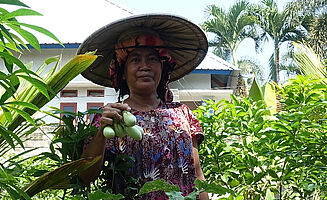
“Over the next two years, the member churches of the Evangelical Mission in Solidarity (EMS) are investing over €3 million in joint projects. This sends a powerful signal of solidarity in difficult times,” says Dr Dieter Heidtmann, General Secretary of the Evangelical Mission in Solidarity (EMS). A good 40 per cent of the projects approved are in the sectors of ministry and combatting poverty. “The projects cover a wide range of aims, for example the sustainable cultivation of fruit and vegetables or support for children’s homes, schools and residences for the elderly.”
The 17 members of the international EMS Mission Council approved funding for a total of 51 projects submitted by EMS member churches in Indonesia, India, Ghana, South Korea, South Africa, Jordan and Lebanon. In 2021 and 2022, the projects will receive funds totalling €1.52 million a year.
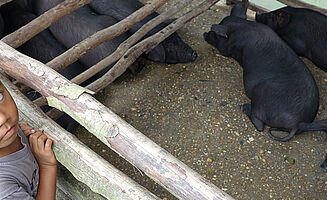
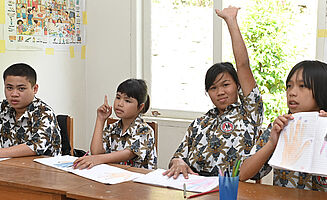
One example is the children’s home of “Titipan Kasih” (“Entrusted with affection”) in Makassar on the Indonesian island of Sulawesi. The home cares for about 70 children and young people aged between two and 20 years old who mainly come from dysfunctional and traumatised family backgrounds. The youngest of them, little “Rain”, got her name when she was left as a new-born baby on the doorstep of the children’s home on a rainy day. The children and young adults go to school or attend a vocational training course. Guided by their caregivers, they help with cooking and household chores, take care of each other and the younger children.
Almost a third of the planned funds, in fact €100,000 more than in the last funding cycle, will be channelled into theological training and interfaith dialogue over the next two years. For example, money will go to fund the Centre for Interfaith Studies and Engagement in Africa (CISEA) of the Presbyterian Church of Ghana (PCG). The CISEA organises conferences, seminars, symposiums and workshops on topics such as relationships between Christians and Muslims, good neighbourliness and peaceful coexistence. Together with participants from other religions, church co-workers, women’s groups, young adults and students learn side by side about the causes of religious conflicts. Ghana still experiences frequent violent clashes between various religious groups.
Press contact: Regina Karasch-Böttcher, karasch-boettcher@dont-want-spam.ems-online.org, Tel. +49 711 636 78 85
Information: Christine Grötzinger, groetzinger@dont-want-spam.ems-online.org, Tel. +49 711 636 78 34
Our Projects
- Cameroon
- China
- Germany
- Ghana
- India
- Indonesia
- Japan
- Jordan
- Korea
- Lebanon
- Malaysia
- Nigeria
- South Africa
- South Sudan
- All
- Cameroon
- China
- Germany
- Ghana
- India
- Indonesia
- Japan
- Jordan
- Korea
- Lebanon
- Malaysia
- Nigeria
- South Africa
- South Sudan
- All
Cameroon is located on the border between the anglophone part of West Africa and francophone Central Africa. A bloody conflict rages in the southwest of the country, caused by the political repression of the…
HIV educational work, support for those affected and their relatives, and modern medical technology: the health services provided by the Presbyterian Church in Cameroon (PCC) deliver primary healthcare for the rural…
In catastrophes and crises, the ability to respond quickly becomes a matter of survival. Thanks to EMS emergency aid, we are effectively prepared for such situations.
With your donation towards “general work”, you are supporting the various tasks of the EMS, exactly where your help is needed most urgently.
Many people in Ghana cannot afford a doctor. The Presbyterian Church offers a “Poor and Sick Fund” to help these people receive medical treatment free of charge.
The various religions in Ghana mostly live peacefully side by side. To ensure that everything stays this way, private and governmental institutions support the dialogue between the religions continuously. The…
To help reduce violence in Ghana, young adults, teachers and pastors receive non-violent conflict resolution training. The so-called “Peacemakers” are on a mission of peace!
Caring for a sick child means more than just investing a lot of time. It also involves treatment costs which often bring families to the limits of their endurance. How can we help them? The Presbyterian Church of…
Women in Ghana were given equal rights by law in 1992. However, they are still at a disadvantage compared with men when it comes to education and the labour market. An animal rearing project developed by the…
With its children’s homes, the Church of South India is systematically advocating better living conditions for boys and girls who need help.
India is the world's fastest growing major economy. While part of India's population participates in the growing economic prosperity, another part does not. India is a country of inequalities. One look at the…
In India, two thirds of the people live in poverty. Over 30 percent are considered as extremely poor. Pastors from the Church of South India stand by them and support them with their problems. But for them, it is…
The Church of South India (CSI) is committed to serving the people of India's southernmost states in a variety of ways. Its mission is not only to proclaim the faith, but also to actively serve society. It meets the…
India is a country of enormous cultural and religious diversity but where the gap between rich and poor is gradually growing. Indian theology students must be trained to face these challenges.
Indonesia is a country with thousands of islands and countless coastal areas, but its economic potential through access to the sea is far from exhausted. The Christian Church in South Sulawesi (GKSS) is launching a…
Since Indonesian village schools are poorly equipped, many parents send their children to secondary schools in the city. There the children find lodging and supportive care in Christian boarding homes.
The district of Mamasa is located inland in the Indonesian province of West Sulawesi. Although its landscape is hilly and rich in water, it is distant from the coast and major cities. Many families work in the rice…
Many people in the rural regions of Sulawesi live in poverty. The Christian Church in South Sulawesi (GKSS) runs an agricultural project which trains farming women and men in well-founded cultivation methods to…
In Indonesia's remote rural regions, children have fewer education opportunities than in cities. Village schools often lack teachers or the right equipment. The Protestant Church in South East Sulawesi is creating…
The Tugutil tribe lives in the forests of Halmahera. Multinational corporations are mining there, destroying the natural environment and thus the Tugutil's livelihood. The Evangelical Christian Church in Halmahera…
There is an enormous need for ecological and social business concepts for small and medium-sized enterprises on the island of Bali. Together with the Dhyana Pura University, the Bali Church is actively working on…
Many young people from different regions of the country live on the Indonesian island of Sulawesi. They often struggle with identity issues at their new place of residence. The church music laboratory run by the…
In Kulawi, a region in Central Sulawesi, the population is severely affected by the consequences of climate change. The Protestant Indonesian Church in Donggala (GPID) is therefore training farmers in sustainable…
Many people in West Sulawesi live from traditional agriculture and raising livestock. Their income is low and many families suffer because of this. The Christian Church of West Sulawesi (GKSB) is now striving to…
In Indonesia, heavy rains and flooding have become more and more frequent due to climate change. The often indiscriminate clearing of forests has now resulted in soil erosion and landslides, which in turn threatens…
Sulawesi is one of the poorer islands in Indonesia. Religious conflicts, a lack of food or the danger of AIDS are only some of the local problems. The churches are battling intensively to sustainably improve the…
Christians are a minority in Indonesia. EMS currently supports four projects in its Indonesian member churches, which deal with the education and training of volunteers and pastors.
“Your handicap is a punishment from God.” Children with disabilities in Indonesia still suffer from this stigma. A women's initiative of the Taraja Church breaks through the isolation of these children and stands up…
Young adults living in rural communities on Sulawesi have hardly any training opportunities at all. The Toraja church supports young adults on their career paths so that they can build a better future for…
A better understanding of one’s own faith; understanding other religions; or learning more about Asia and Christian theology – this is all possible with the Interreligious Studies in Japan Programme.
When compared internationally, Japanese prisons have a very strict discipline. The United Church of Christ in Japan (KYODAN) visits people in prison and provides them with pastoral care.
The Buraku is a Japanese minority which is constantly faced with social discrimination. Although they were granted equal rights by law in 1871, everyday life is a totally different story. The KYODAN Church stands up…
Many parents in Jordan are ashamed of their blind children and hide them away at home. An integrated school in Irbid gives these children prospects for the future – through elucidation and a decent education.
Education for all – this is the guiding principle of the Theodor Schneller School in Jordan. Children and young people from poor and difficult circumstances are offered a chance at a better life.
Poverty in old age is a major issue in Korea. It is only recently that pension insurance was introduced there, which is why elderly people often find themselves in financial difficulties. Poverty also quickly…
Hope exists in Lebanon: At the Johann Ludwig Schneller School, children and young people are given the chance of a better life. They can go to school, learn dialogue between cultures, and are prepared for the future…
Human trafficking, exploitative working conditions, abuse at the hands of partners: the violence, to which women in Malaysia and Indonesia are subjected, has many faces. Together with Swiss missionary group Mission…
The supply situation in the northeast of Nigeria is a precarious one. In addition to the poor economic situation and environmental issues, the terrorist threat posed by the jihadist militia Boko Haram has aggravated…
Nigeria has the largest population in Africa with about 230 million inhabitants. The country is facing major challenges: unemployment and inflation are very high and this affects women and young adults in…
"Every step forwards and each smile makes all our efforts more than worthwhile," says Lesinda Cunningham, head of Elim Home. Since 1963, Elim Home in South Africa has provided a place to live for children with…
South Africa is regarded as a pioneer on the African continent. However, the country is struggling with extremely high unemployment rates. Youth unemployment in South Africa is among the highest in the world. The…
AIDS destroys the livelihood of many South Africans and their families since those infected can find no jobs and children are left as orphans. The "Masangane" project brings back hope to AIDS sufferers and to the…
Education is the key to a better life – particularly in a poor country like South Sudan. The Presbyterian Church of South Sudan (PCOSS) is campaigning to allow as many children as possible to take their opportunity…
Child and maternal mortality rates are extremely high in South Sudan. Training young women as midwives saves lives. At the same time, it also provides genuine professional prospects.
South Sudan is the youngest country in the world. Its road to independence has been associated with unimaginable suffering. Even now, many people are still deeply traumatised by war and violence. Together with…